


A dream of someone you miss, a meaningful song or an intuitive moment may lead you to wonder whether mediumship is part of your spiritual life. Many people who believe in spirit connection describe it as a gift of service: a responsibility to approach others with care.
You do not need to decide on an identity straight away. The five experiences below are things people sometimes associate with mediumship, not a test that can confirm contact with the deceased. Curiosity works best when it leaves room for memory, imagination, ordinary sensitivity and uncertainty.
What makes mediumship different?
In common spiritual language, a medium focuses on claimed communication with people who have died. A psychic reading may focus more broadly on intuitive impressions, symbols or life questions. A person can use both labels, but that does not make every hunch or vivid dream an act of mediumship.
If you choose to speak with a practitioner, ask how they describe their method and limits. No one should guarantee a particular contact or insist that someone who has died requires you to make a payment or a major decision.
Five experiences to reflect on
1. Vivid dreams, inner images or faces
Dreams and mental pictures may feel unusually detailed. Within a spiritual practice, someone may describe this as clairvoyant imagery. You might find comfort in a dream of a person you miss or use an image as a symbol for your own feelings.
A thoughtful response: Write the original image or dream before deciding what it means. Ask what memories or recent events might be connected. An image is not evidence that a visitor is present, and a dream need not predict anything to matter to you.
2. Hearing your name or an unexpected phrase
Some people describe an inner phrase as clairaudience; others mean a sound that seems external. Those experiences need different descriptions. A remembered thought, ordinary self-talk and a voice that seems to come from the room should not all be treated as the same thing.
A thoughtful response: Do not assume that a calm or kind voice must be spiritual, or try to produce voices through isolation, static or sleep loss. Hearing voices or sounds others do not hear deserves medical advice, particularly when new or distressing.
3. Feeling overwhelmed in crowds
A noisy gathering can leave you wanting quiet. You may use empath or clairsentient language to describe that sensitivity, but tiredness or discomfort does not demonstrate that you are carrying someone else’s emotions.
A thoughtful response: Take an ordinary break when you need one. Notice sound, light, physical comfort, stress and how long you have been there. Ask people about their feelings instead of treating your own sensation as their unspoken truth.
4. Songs or meaningful words coming to mind
A lyric may appear just when you are thinking about a loved one or a decision. Some people make it part of a spiritual practice; others experience it as memory or association. You can enjoy the connection without needing to identify an unseen sender.
A thoughtful response: Note the words and what they bring up for you. If the lyric inspires a kind action, make sure that action also respects real-world boundaries. It cannot cancel a breakup, a no-contact request or someone else’s choice.
5. A sudden idea about how to help
Friends may turn to you because you listen well, and an answer may come quickly. Claircognizance is one spiritual label for a sense of knowing. Whether you use that word or not, the other person’s needs and consent still matter.
A thoughtful response: Try “Would you like a suggestion, or would listening help more?” Present an idea as an idea. Do not make diagnoses, announce someone’s hidden motives or claim to deliver a deceased person’s instructions.
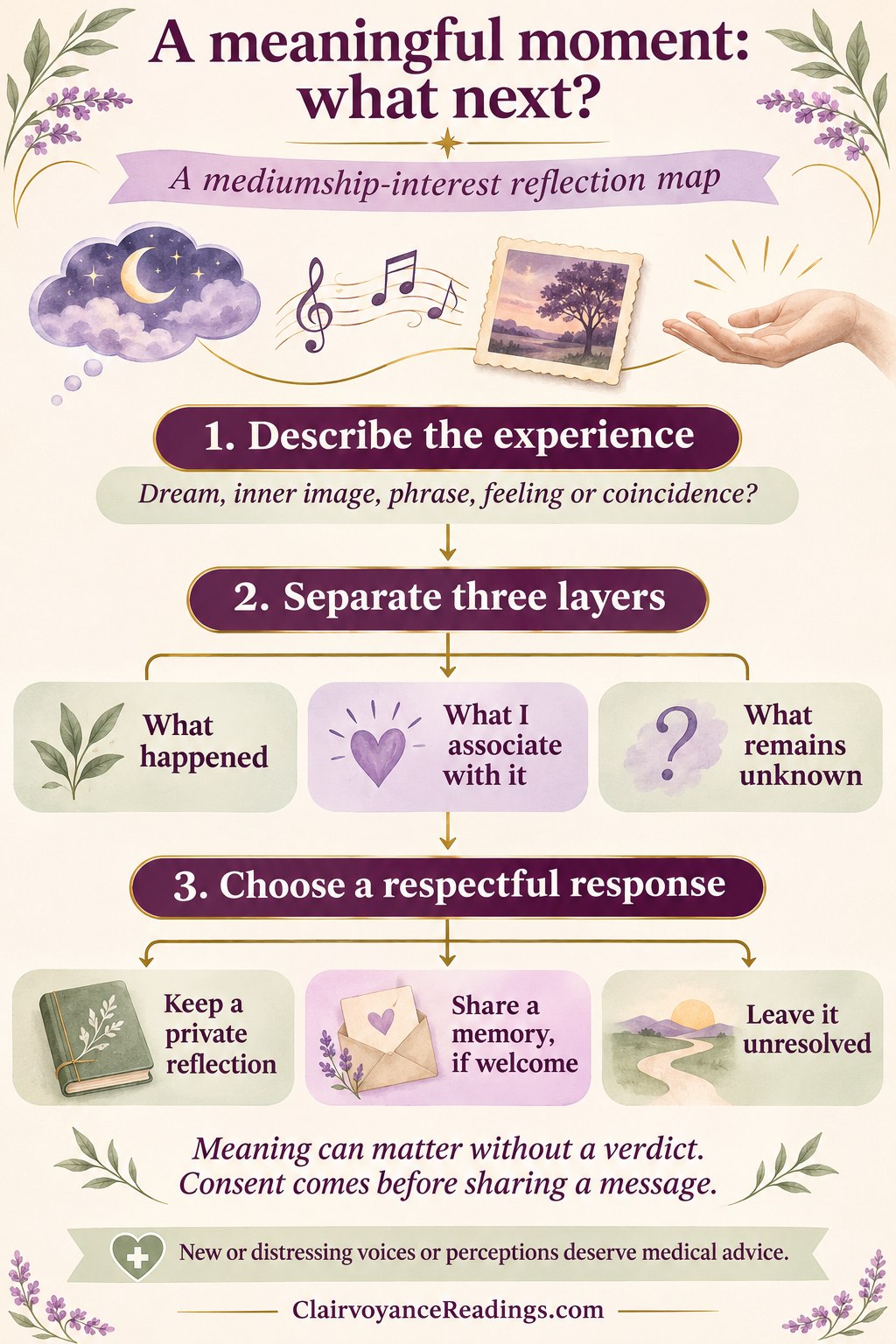
A sense of meaning does not require a verdict
You may understand a dream or a coincidence as part of your connection with someone who has died. Another person may understand a similar moment differently. You can keep the comfort or personal meaning without presenting it as a fact someone else must accept.
For questions about remembrance and closure, read our guide to readings, grief and meaning. A reading is optional; it should not become a condition for remembering a loved one or receiving support.
Free mediumship-interest reflection sheet
Copy these six prompts into a private note. Use one short entry if an experience occurs naturally; you do not need to look for signs all day.
- Experience: What exactly happened, and when?
- Context: What was I remembering, expecting or noticing already?
- Interpretation: What spiritual meaning, if any, am I considering?
- Alternatives: What other explanation could fit?
- Check: If I made a factual claim, what would count as a match, a miss or unknown?
- Effect and boundary: Did this help me reflect, or increase worry? What will I do next, and when will I stop?
Example: “I dreamed about my grandfather’s garden after looking at an old photograph. It felt comforting. I cannot establish spirit contact from the dream, but I would like to share a memory with my sister if she wants to talk.”
Learning with a teacher or development group
Watching a demonstration may help you understand a style, but it cannot show everything about the preparation, editing or information available. You do not need to imitate a performer’s confidence or take on a role you are not ready for.
Ask a prospective teacher about their tradition, training, fees and approach to consent. Can you decline an exercise? How do they respond to an incorrect impression? Are confidentiality and clear boundaries part of the group? Do they support someone seeking healthcare when needed?
A suitable learning environment lets people be uncertain. Avoid promises that a course will certify supernatural accuracy, pressure to book more sessions or a demand to accept one interpretation of your experiences. Our reader-selection guide offers related questions about communication and terms.

Service begins with permission
Even a well-intended message about death can be intrusive. Do not approach strangers with unsolicited claims about their loved ones or investigate private information to create a convincing impression. If a friend freely agrees to a reflective exercise, make it easy to stop and accept “that does not fit.”
Keep ordinary professional roles separate. Being interested in mediumship does not give a caregiver, therapist, teacher or massage practitioner permission to introduce spiritual claims into someone else’s care. Ask what the person wants, respect the role’s boundaries and work within actual qualifications.
Leave room to be curious
You can explore mediumship as a spiritual interest without treating every experience as a message. Honest reflection, respectful boundaries and the freedom to change your mind are useful foundations whether you continue with the practice or choose another way to express your spirituality.
Frequently asked questions
1. Is mediumship a gift?
Many spiritual traditions describe mediumship as a gift or a form of service. That belief does not make a personal experience a verified communication from someone who has died.
2. What is the difference between a psychic and a medium?
In common spiritual usage, a psychic offers intuitive impressions, while a medium focuses on claimed communication with the deceased. Practitioners may use both descriptions, so ask what a particular session includes.
3. Do vivid dreams mean I am a medium?
A vivid dream can be meaningful, but it does not establish mediumship. Record the dream before interpreting it and keep its emotional value separate from any factual claim.
4. What if I see faces when I close my eyes?
You can describe the image without deciding it is a visitor. If unusual perceptions are distressing, new or interfering with daily life, seek healthcare advice rather than trying to intensify them.
5. Is hearing my name a message from a spirit?
The experience alone cannot establish its source. Hearing voices or sounds others do not hear warrants medical advice, especially if new or distressing; a kind tone does not prove that a voice is a guide.
6. Can a song lyric feel spiritually meaningful?
Yes, you may use it as a personal reflection prompt. A remembered lyric does not by itself identify who sent a message or confirm another person’s presence.
7. Does feeling drained in crowds show clairsentience?
Crowds may be tiring for many reasons. You can respect your need for a break without assigning the feeling to other people’s energy or using it as a test of mediumship.
8. Does knowing what advice to give make me a medium?
It may reflect attentiveness, experience or intuition. Offer advice modestly and with permission; confidence does not give you access to private facts.
9. Can I explore this interest without becoming a professional?
Yes. You can read about the tradition, reflect privately or attend a suitable group without taking on a professional role or making claims about other people.
10. How should I choose a teacher?
Ask about their approach, training, fees, consent, confidentiality and how they handle mistakes or distress. Avoid guarantees, pressure to buy repeated courses or instructions to stop healthcare.
11. Can I practice giving messages to strangers?
Do not approach people with unsolicited messages about death or private matters. Consent, clear limits and the freedom to decline are essential even in an informal practice.
12. What belongs in a reflection log?
Keep the date, exact experience, information you already had, your interpretation and anything you can fairly check. Include uncertainty and misses; do not change the original wording to create a match.
13. Should mediumship guarantee contact with a loved one?
No. A practitioner should not promise a particular contact or make your grief a reason for repeated purchases. You can remember someone and seek support without booking a reading.
14. When should I pause a practice?
Pause if it causes distress, disrupts sleep or makes daily life harder. Seek medical help for concerning perceptions, and emergency help for voices urging harm, sudden confusion or immediate danger.
15. What is a thoughtful first step?
Choose one private reflection, set a short time limit and finish with an ordinary activity. You can remain curious without deciding that you have a gift or that you need to act on every impression.