


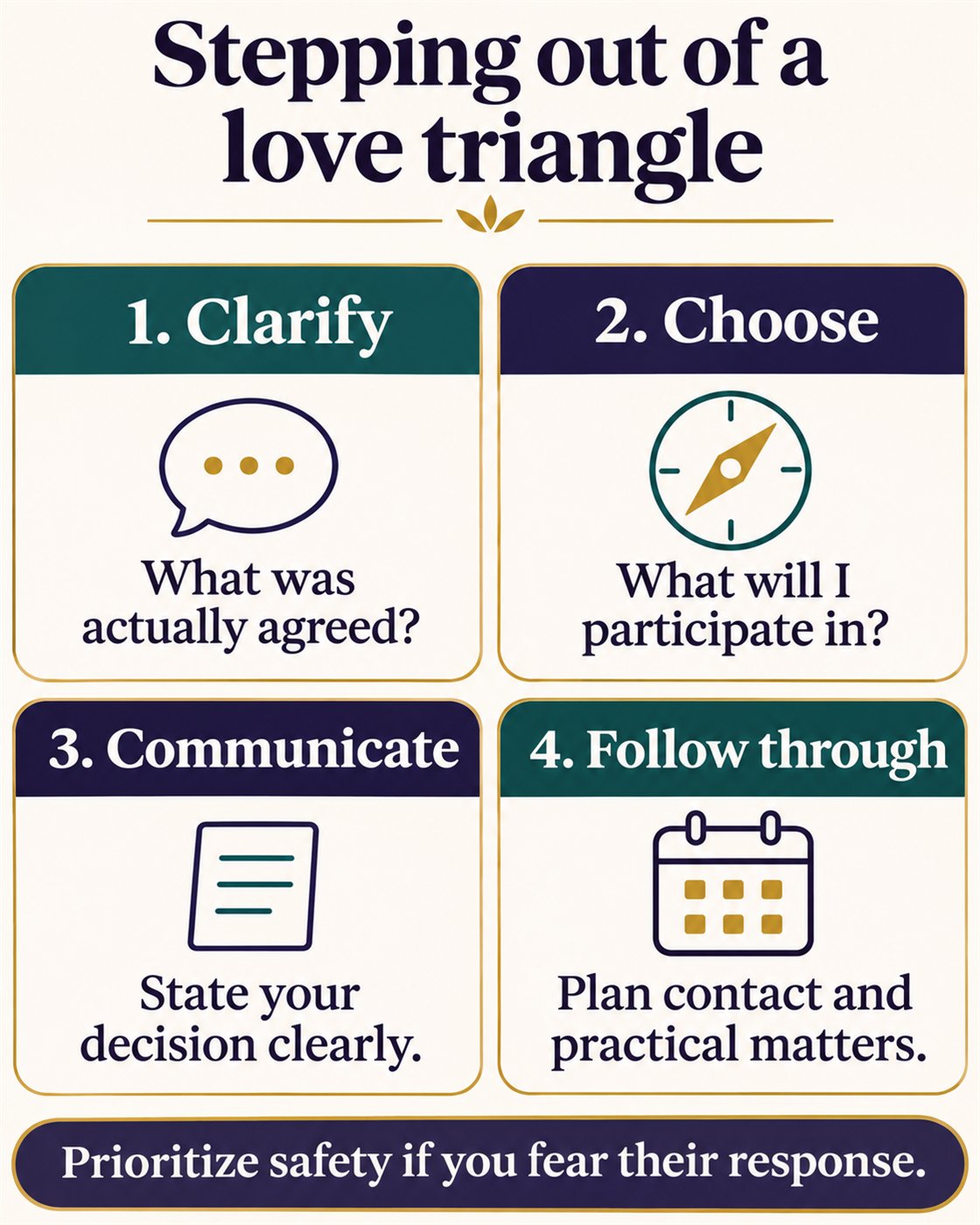
Ending a love triangle begins with deciding what you will participate in. You may not be able to make someone choose you, tell the truth or end another relationship. You can clarify the arrangement, state your own decision and make a practical plan for stepping away.
Being hurt or deceived does not mean you invited the situation. You also do not need to prove that nobody loves you before you leave. The question is whether the relationship available to you fits your needs, agreements and boundaries.
First, clarify what “love triangle” means here
The phrase can describe several situations: two people interested in the same person, dating before exclusivity has been discussed, a hidden overlapping relationship, or a relationship arrangement that someone no longer wants. These are different problems. Having feelings for more than one person is not the same action as breaking an agreement or misleading someone.
If everyone knows about and freely agrees to a non-exclusive arrangement, that is different from secrecy. You can still decide that the arrangement does not suit you. Consent to a relationship structure should not be extracted through pressure or treated as something you can never reconsider.
When it is safe to ask, use specific questions: “Are we exclusive?” “Are you currently in another relationship?” “What have you told the other person about us?” You can make a decision if the answers remain unclear. You do not need to search someone’s accounts, demand their passwords or become an investigator.
Choose a boundary you can act on
A boundary describes your participation. “I will not continue a secret relationship” is a decision you can carry out. “You must stop having feelings for someone else” asks for control over something you cannot enforce.
Love is respect’s explanation of boundaries and expectations stresses discussing what each person wants instead of assuming that an earlier relationship’s rules apply. That discussion can reveal a workable agreement or a difference neither of you wants to accept.
| Your situation | A boundary or question |
|---|---|
| You never discussed exclusivity | “I want an exclusive relationship. Is that something you want with me?” |
| You are being asked to remain a secret | “I am not available for a hidden relationship, so I am stepping away.” |
| They keep asking for more time to choose | “I am not continuing while you decide. Please respect my decision to stop dating.” |
| You are dating two people and want to stop | End each connection honestly as needed, without comparing the people or asking them to compete. |
These are examples to adapt, not requirements to issue an ultimatum. If you already know that you want to leave, you can say so without opening another negotiation.
Say what you have decided without putting anyone on trial
Keep the message focused on the relationship you are ending and the contact you want afterward. You can acknowledge a feeling while still stating a firm choice.
- If you are ending the connection: “I care about you, but this situation does not work for me. I am ending our romantic relationship. Please do not contact me to discuss getting back together.”
- If you share practical responsibilities: “I am ending the romantic relationship. Please use email only to arrange the return of our belongings.”
- If you contributed to the secrecy: “I was not honest about the situation, and that was unfair. I am ending this relationship. I will not ask you to keep waiting or take responsibility for my decision.”
You do not have to rank two people, share intimate details or get everyone to agree with your reasons. Avoid promising a future reunion just to soften a clear ending. If you genuinely remain undecided, say that plainly rather than presenting uncertainty as a commitment.
Plan the next contact before the first lonely evening
Write down what still needs resolving: belongings, an event you planned to attend, a work connection or shared responsibilities. Separate those tasks from conversations about the romance. Choose a channel and a limited purpose for necessary contact.
For example, you might arrange one collection of belongings through a trusted person, decline a shared social event or mute updates that keep drawing you back into comparisons. Where children, housing or finances are involved, a simple block may not solve the practical problem. Obtain appropriate support for those responsibilities instead of making a rushed arrangement under emotional pressure.
A fictional example: stepping out of indefinite waiting
Morgan has been seeing Alex, who says a previous relationship will end “soon.” Each time Morgan asks what has changed, Alex asks for another month. Morgan decides that waiting in secret no longer fits the relationship they want.
Morgan sends a short ending message and arranges to collect a coat through a mutual friend. When Alex later sends an affectionate message without a changed situation, Morgan does not treat the affection as a new agreement. The practical task is already settled, so no reply is needed to complete it.
Choose support over retaliation
You can tell a trusted person what happened and ask for help. You do not have to protect someone’s reputation by staying silent about your own experience. At the same time, a public campaign, threats or sharing intimate material can pull you further into a conflict and harm other people.
If you are considering telling the other person, pause over purpose, safety and accuracy. Share only what you know directly, if you decide to contact them; avoid speculation, demands or using disclosure as leverage. You cannot control whether they believe you, reply or remain in their relationship. If you fear retaliation, get individual support before making contact.
It can help to ask a friend for something specific: company after the conversation, help returning an item or a reminder of the boundary you chose. Missing someone afterward does not, by itself, answer whether resuming the same arrangement would be good for you.

If you are afraid of the reaction, change the plan
Threats, stalking, monitoring or fear of violence require a different approach from an ordinary breakup conversation. You do not owe an in-person meeting when it would put you at risk. Love is respect’s breakup safety guidance recommends planning around your circumstances and involving trusted support.
Use a safe device to seek help if your communications may be monitored. Preserve threatening messages where it is safe to do so, and speak privately with a specialist support service about the next step. A public place alone is not a guarantee of safety. If you face immediate danger, contact local emergency help.
Frequently asked questions
1. How do I get out of a love triangle?
Clarify what is happening if it is safe, decide what you will participate in and communicate your decision. Then plan necessary contact, belongings and support so that the ending can be carried out.
2. Should I wait for them to choose me?
You can decide whether waiting fits your needs, but you cannot guarantee their choice. You are allowed to stop dating while someone remains undecided, even if you still have feelings for them.
3. Is dating more than one person always cheating?
No. The important questions include what everyone knows, what was agreed and whether people can consent freely. A hidden overlap or a broken exclusivity agreement differs from openly agreed non-exclusive dating.
4. Do I need the other person’s agreement to break up?
No. They may feel upset or disagree with your reasons, but that does not require you to continue a romantic relationship. Practical responsibilities may still need a separate plan.
5. Should I tell the third person?
Consider your purpose, their safety and yours, and what you know directly. Avoid threats, public humiliation or sharing intimate material. If you fear retaliation, seek private support before deciding whether to contact them.
6. What if we work together or share responsibilities?
Set a narrow channel and purpose for necessary contact where possible. Keep practical messages separate from romantic discussions, and seek appropriate support for responsibilities that cannot be resolved by simply cutting contact.
7. What if I miss them after leaving?
Missing someone can coexist with choosing to leave. Revisit the reasons for your decision, keep supportive routines and give yourself space before acting on a moment of loneliness.