


Love can bring up questions about safety, enjoyment, independence, care and shared purpose. If chakra symbolism is meaningful to you, the familiar seven-chakra framework offers a way to reflect on those different parts of a relationship.
Chakras belong to spiritual traditions with South Asian roots. Cleveland Clinic’s overview of the seven chakras describes them as a belief-based framework and possible metaphor, rather than established anatomical structures. Here, each theme becomes a question about lived experience. The answers come from what you and your partner say, choose and do.
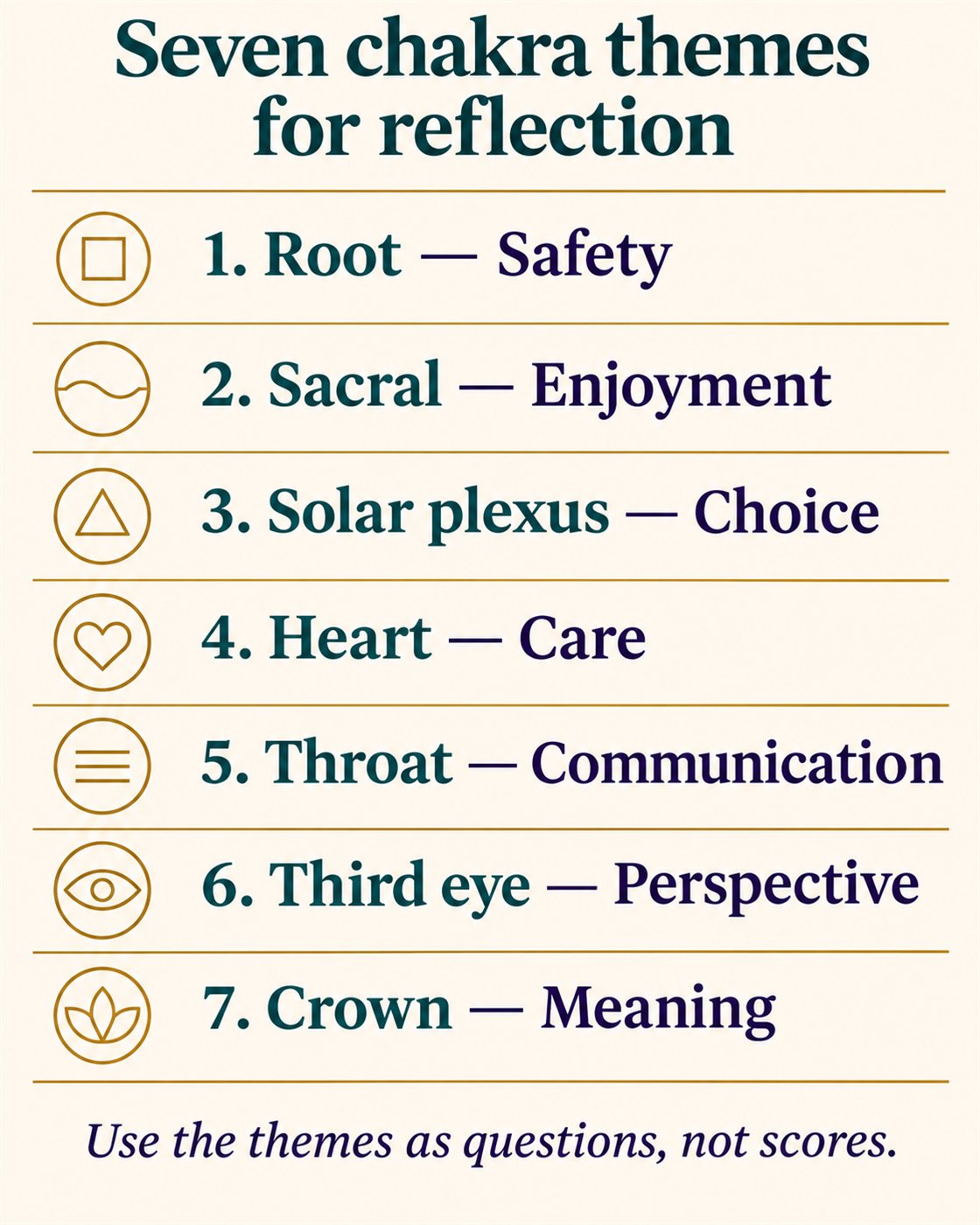
Seven chakra themes for reflecting on love
1. Root: do I feel safe and steady?
The root theme invites you to consider stability. Can you disagree without fearing punishment? Are plans and promises reliable enough for the life you share? Do you retain access to friends, money and support?
A useful reflection is: “What would help me feel more settled this week?” The answer might be a clearer plan, a practical conversation or time with a trusted person. If you are experiencing harmful relationship patterns, attend to the behavior itself. Another person’s threats or control are not caused by your failure to ground yourself.
2. Sacral: is there room for freely chosen enjoyment?
The sacral theme can prompt reflection on pleasure, creativity and closeness. What do you enjoy together? What do you enjoy separately? Can either person decline affection, sex or an activity without being pressured?
Choose one small invitation that leaves room for a genuine answer: “Would you like to cook together on Saturday, or would another plan suit you?” Desire is not a debt. Different levels of interest call for respectful discussion, not a judgment that one person has deficient energy.
3. Solar plexus: can I make my own choices?
Use this theme to consider agency and confidence. Notice whether you express preferences or automatically agree to avoid discomfort. Independence can coexist with commitment; you do not have to erase your opinions to maintain a bond.
Try naming a choice without defending your whole character: “I want to visit my friend that evening. Let’s find another time for our dinner.” Then consider the response. A healthy conversation can include disappointment while still respecting your right to decide.
4. Heart: how is care expressed in practice?
The heart theme is an invitation to notice compassion, appreciation and reciprocity. Name a recent action that helped you feel cared for, and consider whether both people have opportunities to give and receive support.
Care also includes limits. You can understand someone’s pain without accepting mistreatment, forgiving immediately or resuming a relationship. “Unconditional love” should not become a demand for unlimited access to your time, body or attention.
5. Throat: can we communicate honestly and listen?
Reflect on how you raise concerns and receive answers. Are you able to say what you mean without threats or tests? Does your partner get space to disagree? Listening matters as much as making a heartfelt statement.
Describe one event, its effect and a request: “When our plans changed and I did not hear from you, I was unsure whether to wait. Could you send a message next time?” The goal is an understandable conversation, not proving that someone else’s throat chakra is blocked.
6. Third eye: what do I know, and what am I assuming?
This theme can support perspective. An uneasy feeling may prompt you to look more closely, but it does not reveal another person’s private thoughts. Separate the observation from the story you have attached to it.
For example, “They have replied less this week” is an observation. “They must want to leave” is an interpretation. You can ask about the change, notice the answer and decide what you need. Neither intuition nor a reading can substitute for the other person’s consent or establish a hidden relationship agreement.
7. Crown: what meaning do we each want to share?
Reflect on values, purpose and the wider life around your relationship. Do you want similar things from partnership? Can you respect differences in belief? A shared ritual might be meaningful, but neither person must adopt the other’s spiritual language.
You could ask: “What would a satisfying ordinary year together look like?” Answers about time, family, work, community and rest can reveal more than declaring that a bond is cosmically destined. Shared meaning develops through freely chosen actions; it is not proof that you must stay together.
A short reflection you can use alone or together
You do not need to work through all seven themes at once. Select the one that relates to a current situation, and set aside a few quiet minutes. Sitting comfortably or taking a gentle walk is enough; no special purchase or demanding exercise is required.
- Describe: Write one recent event without interpreting motives.
- Notice: Name how it affected you and what matters to you.
- Choose: Identify one request, boundary or practical action.
- Review: Notice what happens afterward. An intention matters most when you can see how it is acted on.
A fictional example: from a label to a conversation
Priya says her heart feels “closed” because she has been quiet after a disagreement with Sam. On reflection, she realizes that she is worried about being interrupted again. Instead of treating the feeling as a spiritual defect, she asks for a conversation in which each person can finish speaking.
Sam can agree, ask for a different time or decline. Priya can then assess the actual response. The chakra theme helped her find a question; it did not answer the question for either person.

Keep spiritual reflection connected to real choices
A chakra chart cannot establish whether someone is trustworthy, diagnose a condition or guarantee compatibility. Avoid scoring your partner’s energy or using a spiritual explanation to dismiss a concern they have clearly expressed.
Nor do you need perfect confidence or complete self-love to deserve respect. Personal growth can happen while you receive care from others. If a relationship is unwanted, unsafe or incompatible with your needs, you can act on that information. Our guide to ending an unwanted love triangle offers examples of clear boundaries and practical next steps.
If you fear a partner’s reaction, prioritize private support and a safety plan over a joint spiritual exercise. Reflection is most useful when it increases your freedom to notice and choose.
Frequently asked questions
1. Which chakra is connected with love?
The heart is the best-known love theme in the seven-chakra framework. The other themes can also prompt questions about safety, enjoyment, independence, communication, perspective and shared meaning.
2. Can a blocked chakra cause relationship problems?
A chakra label does not establish the cause of a relationship problem. Look at specific behavior, agreements and circumstances rather than assigning an energy diagnosis to yourself or someone else.
3. Can chakra work fix an abusive relationship?
Spiritual reflection cannot make another person stop abusive behavior. If you are being threatened, controlled or hurt, prioritize safety and specialist support rather than trying to correct your own energy.
4. What if my partner does not believe in chakras?
You can use the themes privately or discuss the underlying questions in ordinary language. Your partner does not need to share a spiritual belief to talk about respect, boundaries and care.
5. Can this framework tell me whether we are soulmates?
No. It can help you reflect on what matters to you, but it cannot verify a destined bond or reveal another person’s private feelings. Their words, choices and consent remain essential.
6. Do I have to love myself completely before I can be loved?
No. You deserve respect while you are still learning, healing or building confidence. Self-reflection is not an entry requirement for receiving care.
7. How do I start without making it complicated?
Pick one theme, describe one recent event and write one practical question. Focus on the answer and the actions that follow instead of trying to rate all seven chakras.