


The early COVID-19 lockdowns changed the daily lives of many married couples: work moved home, routines disappeared and some households took on unfamiliar caring responsibilities. Other couples found welcome time together. The same period could bring closeness in one part of a marriage and strain in another.
Looking back can be useful if arrangements made under pressure have continued long after their original purpose. The task now is to identify what still affects your relationship and decide which routines, conversations or sources of support need to change.
Separate the pressure from the pattern between you
In its 2020 guidance for couples during COVID-19, the American Psychological Association noted that partners could experience different stressors within the same household. Recognizing that difference can make a conversation more specific. It does not make hurtful behavior acceptable.
Ask two questions: “What is making life harder?” and “How are we treating each other while it is hard?” A job change might explain less time together. It does not excuse insults, threats or controlling access to support.
| What you notice | A useful question |
|---|---|
| One person still carries tasks taken on during lockdown | Does the division fit our current work and caring responsibilities? |
| Every conversation turns into household administration | When do we get time to talk as people, beyond the task list? |
| One person has very little uninterrupted time | How can both of us get rest and some privacy? |
| Old arguments return whenever plans change | Which agreement is unclear, and what happens when either person raises it? |
Reset the workload you actually have
Start with the whole job, including noticing, planning and following up. “Doing the shopping” may include checking supplies, making a list, arranging transport and putting things away. If one person must supervise every step, the work may not feel shared even when both people are busy.
List the recurring tasks and agree who owns each one for a manageable trial period. Account for paid work, health, caring duties and realistic capacity. An arrangement does not have to look identical to be freely agreed and workable.
Try: “I am still planning all the meals even though our schedules have changed. Can you take responsibility for two evenings, including the shopping, and we will review how that works?”
Make space without treating it as rejection
Living together does not remove the need for privacy, friendships or time alone. State the kind of space you want and when you expect to reconnect. “I would like half an hour to read after work, then I can talk about dinner” gives your partner more information than disappearing without explanation.
Make the arrangement available to both people. A break that exists only because one person absorbs every household task is not shared rest. If space is limited, you might alternate use of a quiet room, use headphones by agreement or take separate short walks when responsibilities permit.
Have one manageable conversation at a time
Choose a topic and a time when both people can reasonably take part. Start with a recent example, describe its effect and make one request. Try to understand the answer before introducing the next issue.
If an ordinary disagreement is becoming heated, a pause can help you return with more care. Say when you will come back to it: “I am getting overwhelmed. Can we stop now and continue after dinner?” A pause should not become an indefinite refusal to discuss something important.
These habits are invitations to cooperation. They do not make you responsible for preventing another person’s aggression. If you are afraid of the response, prioritize private support over a joint communication exercise.
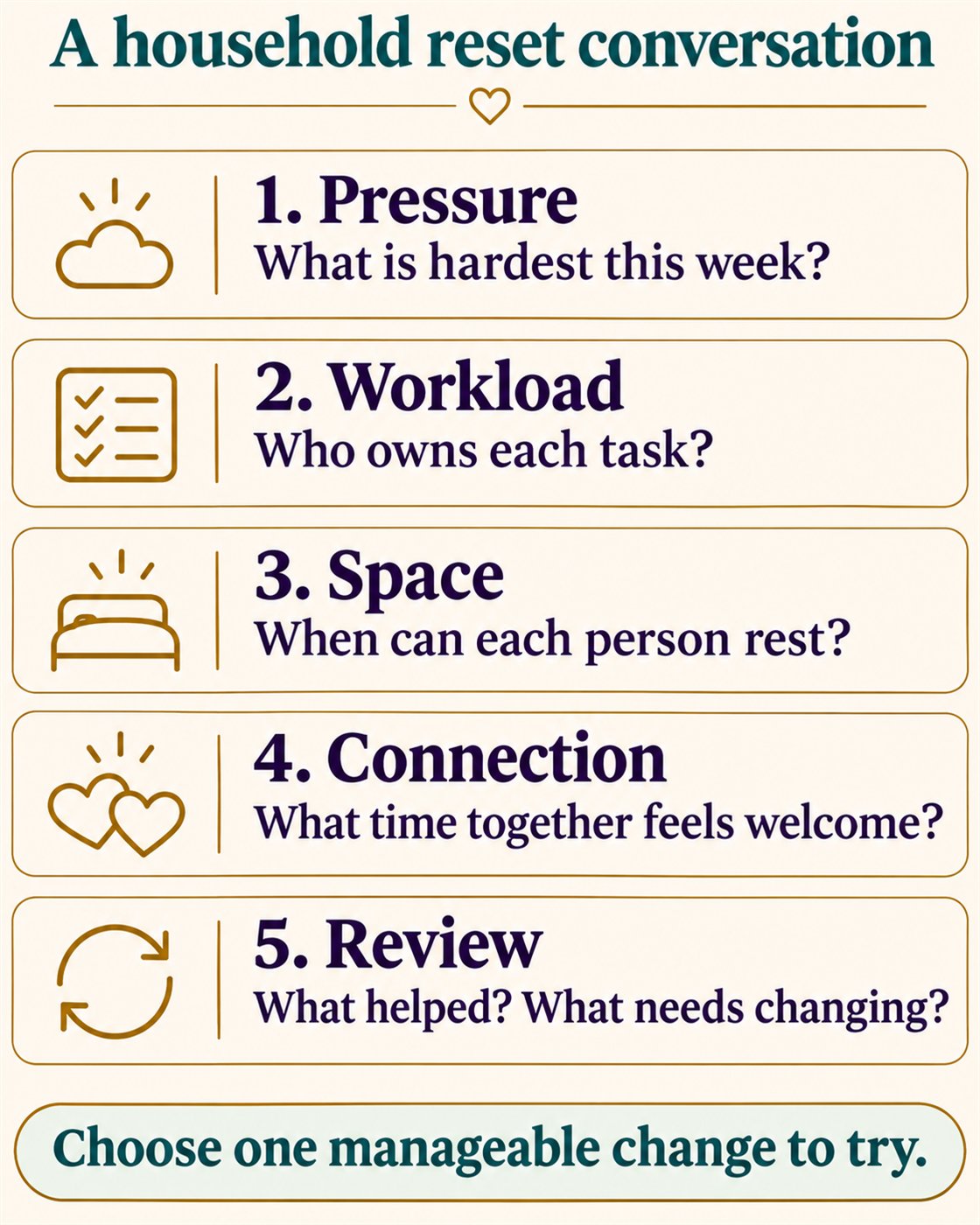
Reconnect without making affection another assignment
Ask what contact feels welcome now. An unhurried cup of tea, a shared meal or an ordinary conversation may be more appealing than a large plan when energy is low. You can suggest something while leaving room for a different preference.
Physical affection and sex should remain freely chosen. A difference in desire is a subject for a respectful conversation, not proof that love has disappeared or that someone owes reassurance through intimacy. Ask your partner what they want instead of relying on a reading, a guess or a test.
A fictional example: the routine that outlasted its purpose
During lockdown, Dana handled evening meals because her work hours were flexible. Years later, she has a fixed late shift, but the household still assumes dinner is her responsibility. Lee thinks Dana is withdrawing because she has stopped suggesting time together.
They identify the practical conflict before trying to interpret each other’s feelings. Lee takes ownership of dinner on Dana’s late days, and they choose one short evening each week to spend together without discussing chores. They agree to review both plans. The outcome depends on what they do next, not on making the perfect promise.
Choose support for the issue in front of you
A trusted friend can listen and help with practical needs. A qualified relationship therapist may help when conversations repeatedly stall and both people want that support. You can also seek individual support even if your partner does not wish to participate.
If a psychic reading is personally meaningful to you, use it as a prompt for your own reflection. It cannot verify fidelity, reveal a partner’s private wishes or guarantee that a marriage will improve. Keep major relationship decisions grounded in direct communication, observable behavior and your own preferences.
Our guide to strengthening a relationship offers further ideas for discussion. There is no requirement to keep trying every exercise before deciding that a relationship no longer works for you.
Where there is intimidation, monitoring, coercion or violence, specialist individual support and safety planning take priority over trying to improve a shared routine. Love is respect’s guidance on leaving safely explains why an ordinary breakup plan may need to change when a partner is controlling or threatening.
Frequently asked questions
1. Can pandemic-era habits still affect a marriage?
Yes. A division of tasks or a communication pattern can continue after the circumstances that created it have changed. Review whether the arrangement fits your lives now rather than assuming it must stay the same.
2. Does wanting time alone mean my partner does not love me?
That preference alone does not reveal how someone feels about the marriage. Ask what kind of space they need and discuss a practical arrangement that also respects your needs.
3. How do we restart a conversation that always becomes an argument?
Choose one issue, describe a recent example and make a specific request. Agree on a pause and a return time if needed. Seek support if the pattern continues, and prioritize safety if you fear aggression.
4. What if only one person wants to work on the relationship?
One person can change their own choices and seek individual support, but cannot make the other participate. Consider what the relationship is offering now and which boundaries or decisions are yours to make.
5. Can a psychic tell me whether my spouse is faithful?
A psychic reading cannot verify fidelity or establish another person’s private thoughts. Address specific concerns through direct conversation and relevant facts, without treating a prediction as evidence.
6. Do we need to divide every task exactly in half?
No. Consider time, capacity, caring responsibilities and whether both people freely agree that the arrangement is workable. Include planning and follow-up as part of each task.
7. How can we tell whether a new routine is helping?
Choose a review point and ask what changed in practice. Look at whether responsibilities were carried out, each person had some space and the arrangement needs adjustment. A trial is information, not a promise of a particular outcome.